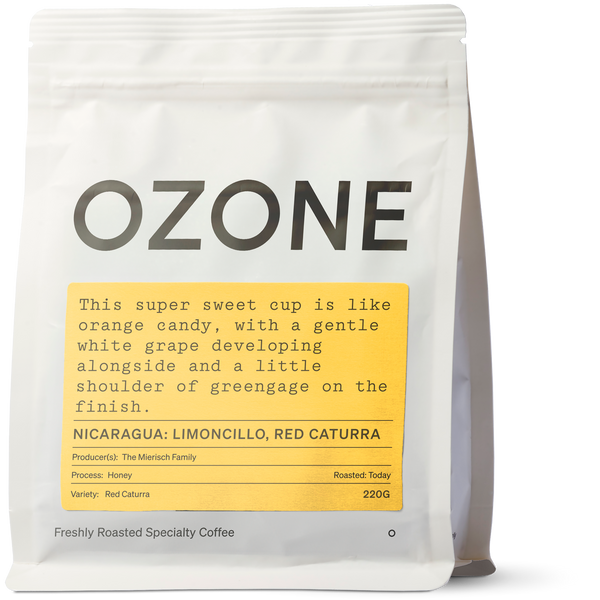
Caturra is one of those coffee varieties that looks fairly unremarkable until you look at what it changed. It started out as a natural mutation of Bourbon in Brazil, producing shorter, more compact plants than the taller coffee trees they came from. That small difference made it possible to plant trees more closely together, making better use of space and making the plants easier to manage and harvest.
That helped Caturra spread through Central and Latin America, where it became an important commercial variety. It is still grown today, although in many areas it has been partly replaced by newer varieties with better resistance to coffee leaf rust.
Where did Caturra come from?
Caturra was discovered on a plantation in Minas Gerais, Brazil, sometime between 1915 and 1918. It is a natural mutation of Bourbon, caused by a single genetic mutation that gives the plant its compact growth habit. The name Caturra comes from a Guarani word meaning “small”.
The plants were selected and studied by the Instituto Agronômico of São Paulo (IAC) from 1937 onwards. Breeders were interested in the short stature and closely spaced branches because they allowed producers to plant more trees in a given area.
Caturra wasn't widely adopted commercially in Brazil, but it travelled north. It was introduced to Guatemala in the 1940s, then spread to Costa Rica, Honduras and Panama. In Colombia, it arrived in 1952 and became one of the country's most important coffee varieties. At one point, Caturra was thought to account for close to half of Colombia's coffee production.
The Caturra Family Tree
Caturra
A spontaneous dwarf mutation of Red Bourbon discovered in Minas Gerais. Its compact growth habit revolutionised coffee farming across Latin America by allowing significantly higher planting densities whilst maintaining Bourbon's prized cup quality. The mutation that made modern specialty coffee farming possible.
Why is Caturra so compact?
The defining characteristic of Caturra is its size. It has much shorter internodes than a traditional Bourbon plant, meaning the gaps between branches and nodes are reduced. The result is a short, dense plant with a lot of productive branches packed into a relatively small area.
That makes a practical difference on the farm. Caturra can be planted at higher densities than taller traditional varieties, while its smaller size also makes pruning, harvesting and other farm work easier.
World Coffee Research gives a typical planting density of around 5,000 to 6,000 plants per hectare for Caturra when plants are managed with a single main stem. Actual planting density varies with the farm, climate, soil, pruning system and local farming practices.
Caturra has medium yield potential according to World Coffee Research. Its advantage isn't simply that every individual tree produces an enormous crop. The compact shape means more trees can be grown in the same space, which is a big part of why the variety became so commercially important.
What does Caturra taste like?
This is where things get a little less straightforward. Caturra is a Bourbon-derived variety, and it has the potential to produce high-quality coffee, particularly when grown at suitable elevations. World Coffee Research rates its quality potential at high altitude as good, rather than treating the variety as having one fixed cup profile.
You'll often find Caturra associated with bright acidity, sweetness and a clean, structured cup. Depending on where and how it is grown, that can show up as citrus, red fruit, stone fruit or floral flavours. Processing plays a part too: washed Caturra can be particularly clean and bright, while natural processing can put more emphasis on fruit and sweetness.
It's worth being cautious about treating those flavours as a guarantee, though. Variety is only one part of the equation. Elevation, climate, soil, picking, fermentation, drying and roasting all have a major influence on the coffee in the cup.
Caturra and coffee leaf rust
The main drawback is disease resistance. Caturra is highly susceptible to coffee leaf rust (Hemileia vastatrix), one of the most important diseases affecting Arabica coffee. World Coffee Research currently classifies it as low resistance or susceptible. It is also susceptible to nematodes and coffee berry disease.
That susceptibility became particularly important as coffee leaf rust spread through Central America. Caturra's popularity meant that large areas were planted with genetically similar, susceptible trees, while producers were under increasing pressure to find varieties that could cope better with disease.
In Colombia, for example, Caturra was gradually replaced in many areas by rust-resistant varieties developed through breeding programmes. Castillo is one of the best-known examples and has Caturra in its genetic background.
That doesn't mean Caturra has disappeared. It is still grown in many coffee-producing regions, particularly where producers value its agronomic characteristics and have the conditions and knowledge to manage its disease susceptibility.
A variety that shaped modern coffee farming
Caturra's importance goes beyond the coffee it produces. Its compact growth habit became useful in breeding programmes, and the variety has been crossed with other coffees to combine its stature with different agronomic traits.
One of the best-known examples is Catuaí, created in Brazil by crossing Caturra with Mundo Novo. The result retained the compact growth habit while adding the characteristics of Mundo Novo. Catuaí went on to become an important commercial variety in Brazil and Central America.
Caturra also became an important parent in the development of the Catimor group. Breeders crossed Caturra with lines of Timor Hybrid to combine its compact growth with resistance to coffee leaf rust. Costa Rica 95, Catisic, Lempira and IHCAFE 90 are examples of Catimor varieties that came from this work.
That makes Caturra a good example of how much influence a seemingly simple mutation can have. Its value wasn't just the coffee produced by the plant itself, but the traits that breeders could carry into later generations.
Why Caturra still matters
There's a reason Caturra has stuck around for so long. It's compact, productive enough to make dense planting worthwhile, relatively easy to work with, and capable of producing very good coffee in the right conditions.
It also shows the trade-offs involved in coffee breeding. The same plant that helped make intensive coffee production more practical is vulnerable to one of the industry's most serious diseases. That has driven a lot of the breeding work that came after it.
So Caturra isn't especially exotic, and it isn't a variety that guarantees a particular flavour profile. It's simply a very important coffee plant. A small natural mutation in Brazil ended up influencing how coffee was planted, bred and produced across much of Latin America.
Quick Varietal Facts
Varietal: Caturra
Species: Coffea arabica
Type: Natural mutation of Bourbon
Origin: Minas Gerais, Brazil, discovered between 1915 and 1918
Genetic background: Bourbon-related
Growth habit: Dwarf/compact, with closely spaced branches
Cherry colour: Red and yellow types exist
Yield potential: Medium
Typical planting density: Around 5,000–6,000 plants per hectare with single-stem pruning
Disease resistance: Highly susceptible to coffee leaf rust; also susceptible to nematodes and coffee berry disease
Quality potential: Good at high altitude
Notable descendants and related varieties: Catuaí and numerous Catimor varieties; Caturra also contributed to later breeding programmes
Typical cup characteristics: Often associated with sweetness, bright acidity and clean fruit character, although cup profile varies considerably with growing conditions and processing
Further Reading
World Coffee Research – Caturra Variety Profile
The technical reference for Caturra, including genetic background, agronomic characteristics, and cultivation recommendations.
Perfect Daily Grind – How to Identify Coffee Varieties
A practical guide to identifying Caturra and other common varietals in the field, with information on physical characteristics and growing regions.
Interested in exploring Caturra's genetic relatives? Check out our articles on Bourbon, Catuaí, and Mundo Novo.